
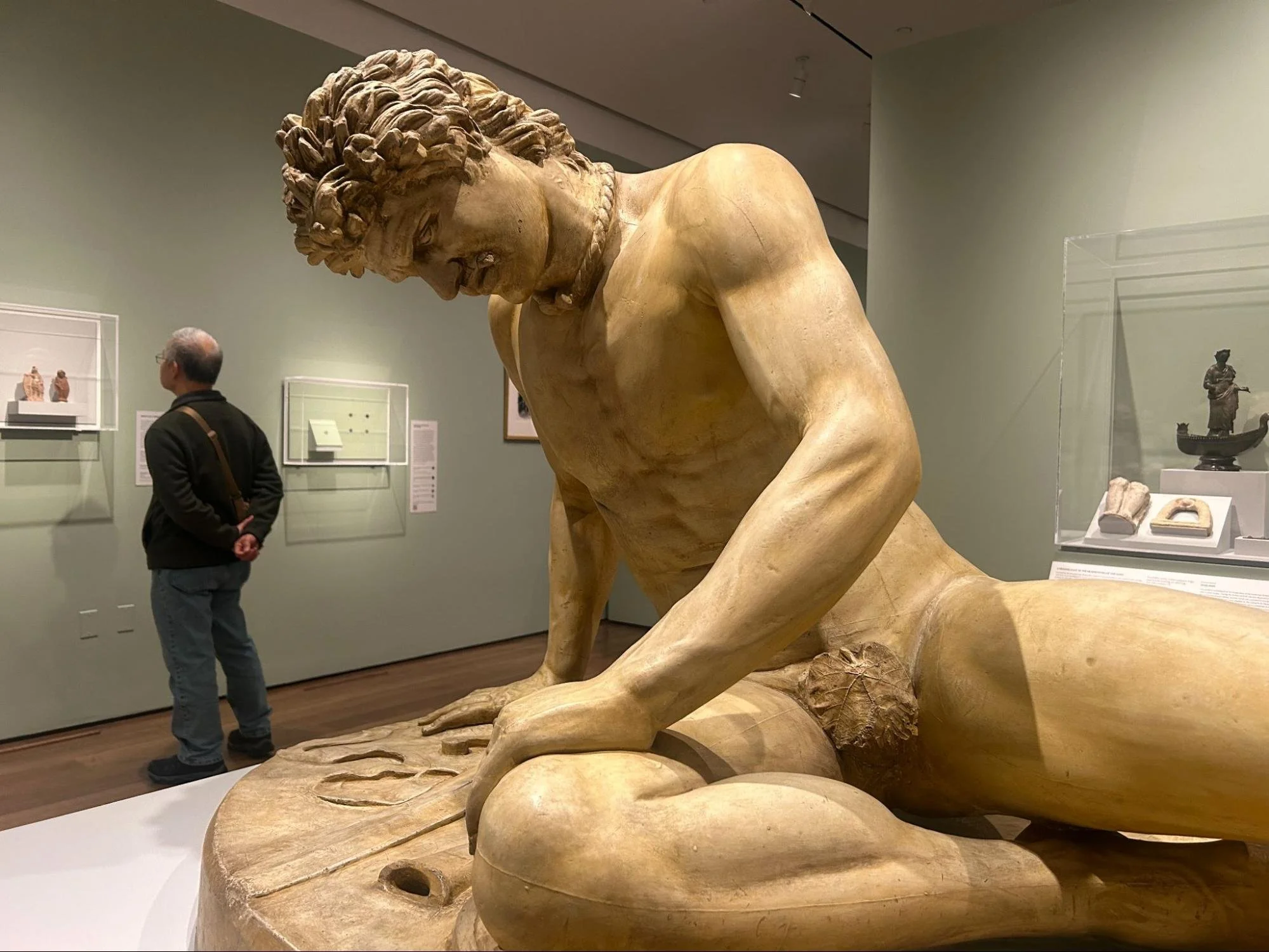
The “Dying Gaul” on view in Celtic Art Across the Ages at the Harvard Art Museums. Photo: Adriana Hazlett.
I decided to go to Harvard Art Museums' exhibition, Celtic Art Across the Ages, because of its name. I heard “Celtic” and assumed the exhibition would be full of ornamental designs on aging manuscripts and green landscapes of the British Isles. I’m drawn like a moth to a flame to anything that resembles our collective fantasy of the Middle Ages. I thought that’s what I would see.
I quickly saw the pieces went far beyond my limited imagination. The exhibition, which ran March 6, 2026, to August 2, 2026, displayed a mixed array of artifacts created by those who have been called “Celts” throughout history. The artifacts date from the Iron Age, to the early medieval, to the Celtic Revival, to the modern. They include Art Nouveau illustrations, an ancient coin engraved with Julius Caesar, a metal “pony cap” from the 3rd century BCE, and Celtic knots on top of Celtic knots. What ties them together is their potential to poke holes in clichéd notions of the Celtic identity.
“This term ‘Celtic’ has endured for nearly 3,000 years, albeit with a huge gap in when it was used,” said Penny Coombe, Kelekian Curatorial Fellow in Ancient Art, to The Harvard Gazette. “What does relate all these very different artifacts to one another, and is that a real relationship? How is this term repurposed and reused in different ways, at different times, and how does it become politically relevant in later periods of building nationalism, building nationhood?”
The term was first used by the ancient Greeks around the 5th century BCE. It was picked up by the Romans as Celti, Celtae, and Galli. Romans used these words to refer to the peoples living to the north of Italy, mainly in central Europe. For nearly four centuries, the Roman Republic came into conflict with Celtic tribes, whom they collectively called Gauls. The majority of Gaul came firmly under Roman control after Caesar’s campaigns in the 1st century BCE, and the image of Gauls as “barbaric” and “savage” in the Roman imagination became firmly entrenched.
The Harvard exhibition features a mold of a Greco-Roman statue entitled the “Dying Gaul.” It depicts a defeated Celtic soldier, bracing himself against the ground. His facial hair marks his identity, as does his Celtic torque. A torque is a thick metal ring worn around the neck, which the Romans marked as a distinctive feature of Celtic warriors. Torques carry deeper symbolism in Celtic culture, as underscored by the numerous and varied torques on display at the exhibition. But the statue itself expresses, quite clearly, the Greco-Roman perception of the Celts as a conquered yet violent people. Like other currents of Greco-Roman thought, this perception runs deep in the United States.
Celtic identity, as it exists in the current American imagination, was further developed centuries later. This was driven by Archaeologia Britannica, the founding work of the study of Celtic languages, written by Edward Lhuyd in 1707. Lhuyd differentiated between two families of Celtic languages: P-Celtic (Welsh, Breton, and Cornish) and Q-Celtic (Irish, Scots Gaelic, and Manx). The work contributed to the growing and prevailing identification of Celts as the people who speak such languages. The Celtic nations—primarily Ireland, Scotland, and Wales—are where these languages survive today. The title page of Archaeologia Britannica was on display at the exhibition. The words “Great Britain” are the largest on the page. American perceptions of the “Celtic” are just as, if not arguably more, influenced by the English and British as they are by the Greek and Roman.
The Harvard exhibition provided a space for the Celtic identity to expand beyond its stereotypes and historical manifestations. In touring it, I was struck by the sense that Celtic culture, as all cultures, exists both within and without physical material. Even so, Celtic Art Across the Ages was a testament to the tangible—to visual art as a powerful expression of identity. It was a testament to an identity as intricate and unbroken as the knot designs that bear its name.
Sources: “Is this art ‘Celtic’? It’s complicated?”, The Harvard Gazette; “Celtic Art Across the Ages,” The Harvard Crimson; “Who were the Celts?”, National Museum Wales; and “Torque (jewelry),” Encyclopaedia Britannica.