
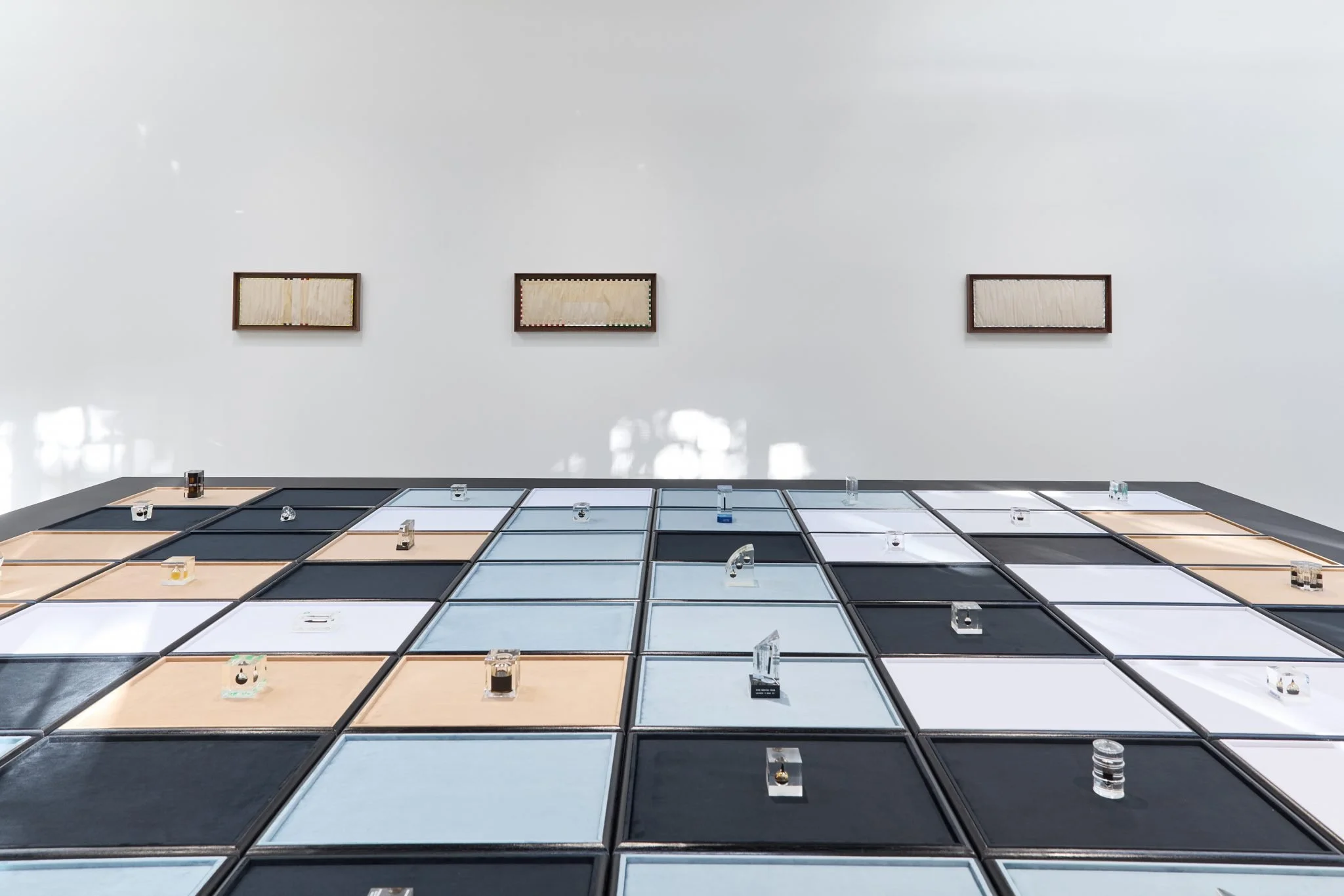
Tanoa Sasraku, Morale Patch, 2025. Installation view at the Institute of Contemporary Arts, London. Photo: Luke Walker.
While studying abroad last semester in London, I spent the majority of my time checking out art exhibitions and museums. I felt as though there were so many important things to see and learn, and I genuinely enjoyed going out of my way to see art. There was one specific exhibition that caught my eye, titled Morale Patch by British and Ghanaian artist Tanoa Sasraku. In this exhibition, she explores the destructive role of oil companies and questions the practice of oil extraction and the industrial sites around the globe. This is done by collecting paperweights produced by oil companies and repurposing the trinkets into a working tiled chessboard. She used physical materials such as oil, wood, ink, and UV light burned onto paper. The chessboard itself calls out oil companies' wealth and power, with the paperweights’ shapes spanning from hourglasses to diamonds. The companies she called into question include Texas Gold, Arabian Light Crude Oil, and Derrick-American Oil Inc.
The US itself uses a large amount of oil. “Every day, the United States burns through roughly 20 million barrels of gasoline, diesel, and other oil-based fuels—enough to fill more than 1,200 Olympic-sized swimming pools,” according to an article by the Union of Concerned Scientists. The use and process of collecting this oil have harmed many parts of everyday life. This includes, but is not limited to, an increase in gas emissions, driving up the climate crisis, upending wildlife habitats, and oil spills. There are many horror stories, especially that have been heard surrounding oil spills, but there haven’t been any major changes to the collection of these resources over time. So what’s the holdup?
The climate crisis shows up in our world today almost comedically. I think it's the only way people can face the idea of a possible “impending doom” that would require large numbers for actual change. The most obvious example of this would be the large climate clock in New York City. It sits near Union Square, ticking away, as people walk by. As someone who lives there, it has become something that people just tend to pass by now, even as the number gets lower and lower. This “comedic effect” stems from the irony of the clock. It could be right in front of us on a big sign, and it still wouldn’t make a difference. I overall didn’t hear a lot of conversations that happened about the climate crisis in my everyday life until I found Sasraku’s exhibition.
I like Sasraku’s approach to the conversation, as she addresses it more bluntly instead of in a comedic manner. The idea of titling the exhibition Morale Patch is deeply ironic. As morale patches in the US are worn by military and tactical personnel to boost morale, oil companies are causing real damage all over the globe. Sasraku displays this out in the open in her exhibit, showcasing six custom screen-printed acrylic paperweights encasing ink with the American flag painted on them.
Impressively, Sasraku can take these almost basic objects and create something meaningful to promote change. It felt refreshing to see something so detailed and delicate have such a larger meaning. Although the exhibition closed earlier this year, Sasraku continues to use physical materials in more of her artworks while commenting on politics and power.